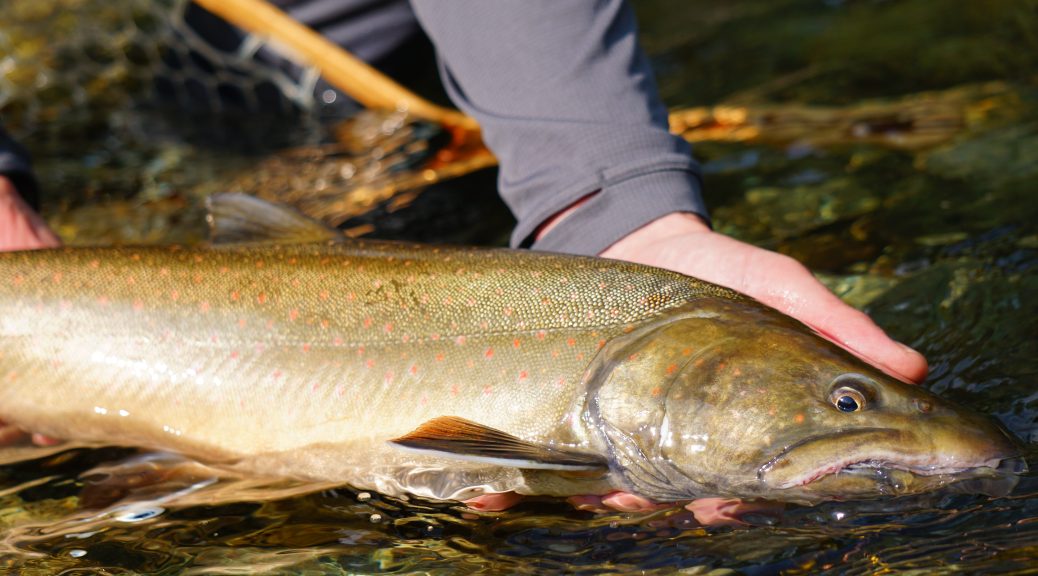
Trout by Name, Char by Nature: The Bull Trout Identity Crisis
*Originally published in 2026 spring edition of ‘Flylines’ magazine by the BCFFF (https://flyfishers.ca/). Consider becoming a member today for $20/year. The focus of the article is fishing in BC, where Dolly Varden and Bull Trout are both native. In Alberta, Dolly Varden have a very limited range in the Upper Peace watershed, but can be also be found in a few lakes where they were introduced.*
I had been at the nice corner bend for around a half hour, casting to a picky cutthroat who refused to eat my fly. I reeled in my line, hooked it onto my rod, and walked back the tail of the pool to join my brother, who was staring discerningly into the pool. He looked at me, stating bluntly “I can see some Bull Trout in there.”
I perked up and began pondering the pool, at the same time saying “You know, I prefer the name Mountain Char.” My brother chuckled “Mountain Char, eh… Don’t most people just call them Dolly Varden?” And so began a conversation familiar to many anglers — why do some people call them Dolly Varden and other people call them Bull Trout?
As far as I was concerned, the real question was why no one was calling them by what they really ought to be named, which is char, not trout. I guess most people aren’t concerned with the difference between a trout, and a char. However, I think not using the name char is a disservice to this group of fish, and partly responsible for explaining why many anglers have no idea what a char is, yet everyone, including non-anglers, know all about the over-revered trout.
Regardless of what we were calling them, my brother was right about the char in the pool. In fact, there were far more then one, now that I looked closely. At least five, hell maybe ten! I looked at my brother and said “Lets stick the go-pro in there.” I grabbed the go-pro, stuck the mount as far into the pool as I could, scanning in all directions, then pulled it out. I then carefully examined the footage on the tiny 2” screen.
The tiny screen revealed to me a pool FULL of large, orange bellied, beautiful char. There were at least 40, tucked neatly into the most subtle, seemingly unremarkable pool. Call em’ what you want, but that much meat in one pool will leave a lasting impression on anyone. And to this day, I’ve never forgot that spot. And each time I’ve returned since, the char have been there, hiding in plain sight…
What’s in a name, anyways?
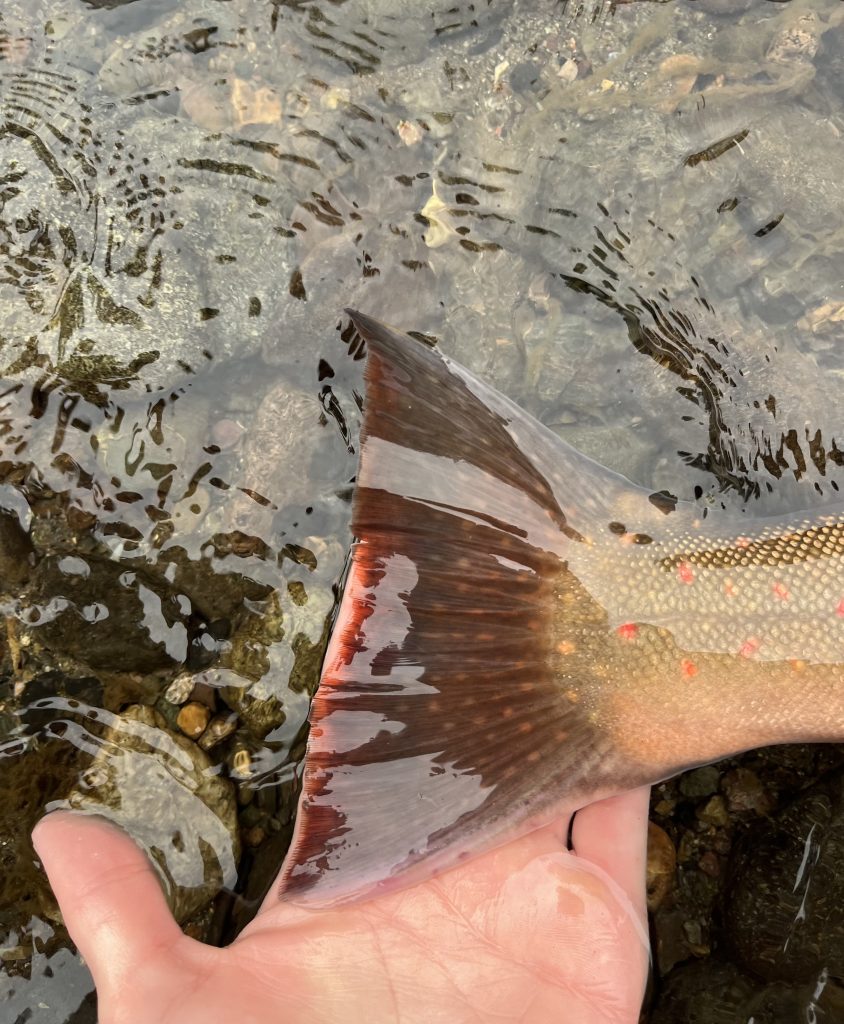
Years before all this happened, I remember reading a Jim Mclennan book, Trout Streams of Alberta, in which Jim described the western char species known as the Bull Trout (Salvelinus confluentus). This was the first I had learned about the species. I remember one thing in particular – Jim didn’t like the name, Bull Trout. After reading his arguments, I agreed with him. I’ve thought of it a heck of a lot ever since then, and I can tell you nothing has changed my mind since.
For starters, Bull Trout aren’t trout at all, rather members of the fish genus known as char, cousins to the Dolly Varden and Arctic Char. Why not adorn them with a name that pays homage to their char ancestry? Or else a name that reflects the grandeur of the environments they live in, rather than an arbitrary comparison to a… Bull? I can think of very few similarities between a sleek, powerful fish and male bovine. Surely, Mountain Char, or Western Mountain Char would be a more fitting, more interesting, and more scientifically accurate name for a fish synonymous with pristine mountain rivers?
For now, that species continues to don the common name, Bull Trout. So then why do so many people call them Dolly Varden, or Dollies?
Some of you might now be saying “I thought Dolly Varden and Bull Trout WERE the same thing?” This is technically more accurate than calling a Bull Trout a trout. Until quite recently, Dolly Varden and Bull Trout were considered the same species– it was only 40 or so years ago when DNA and morphological analyses revealed them as two different species. For this reason, Bull Trout are often referred to incorrectly as Dolly Varden (and why old timers are off the hook for not making this distinction). I will admit that, when it comes to names, Dolly Varden is at least quite memorable. Apparently, they were named after by a character named ‘Dolly Varden’ from the Charles Dickens’s novel, Barnaby Rudge, who wore a colorful, patterned outfit. I can understand the ongoing misnomer, given this memorable backstory.
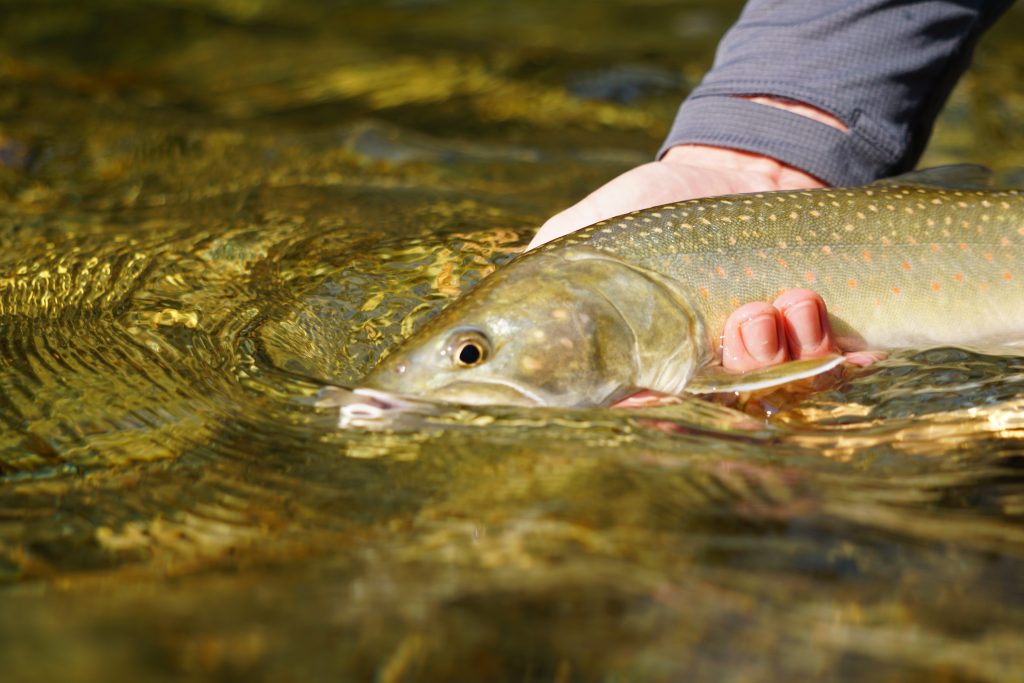
Dolly Varden (actual Dolly Varden, that is) are remarkably similar to Bull Trout, despite diverging from a shared common ancestor around 5 million years ago. Dolly Varden have a distribution in BC that is more northern and primarily coastal (although there are a few exceptions). They tend to have a face that is more blunt, a maxilla that does not extend as far past the eye, and for those who need to be certain, fewer branchiostegal rays than Bull Trout.
Bull Trout are the more common char species across most of the province. There is agreement amongst scientists that there are two distinct lineages of Bull trout— interior and coastal— which likely diverged when they became separated during the most recent ice age. Both lineages persisted through two glaciations and Bull Trout on both sides of the continental divide colonized new habitats as glaciers finally receded, establishing the species widespread distribution seen today encompassing the majority of BC.
Essentially, when it comes to the two species and where they are found in BC, Bull Trout can be everywhere, Dolly Varden are mostly in coastal drainages and more common as one goes north, and while they do look almost identical, can successfully breed together, and occupy virtually the same niche, they are not the same species. Like most fish ecology, it’s complicated.
The Same, But Different
The difference between these two species becomes clearer once they occupy the same streams. When both Bull Trout and Dolly Varden are present together, Dolly Varden will live a ‘stream resident’ life-history, maturing at a small body size while feeding on aquatic insects. The Bull Trout, however, will take on a migratory life-history, growing very large on a diet that mostly consists of other fish. In the absence of the other, both may take on either form. Making matters even more confusing is that they may also hybridize and produce offspring that are, put simply, somewhere between the two species. These hybrids essentially got the wrong end of the evolutionary bargain— not as good at being stream residents, not as good at being migratory piscivores. Just ill-adapted hybrids, caught in an evolutionary battleground. However, a few of these hybrids do survive to reproduce, infusing their hybrid genes back into both gene pools. These interactions can lead to interesting hybrid fish in areas where the two species overlap. So technically, it is possible for a fish to be both a Bull Trout and a Dolly Varden.
Migrants on the Move
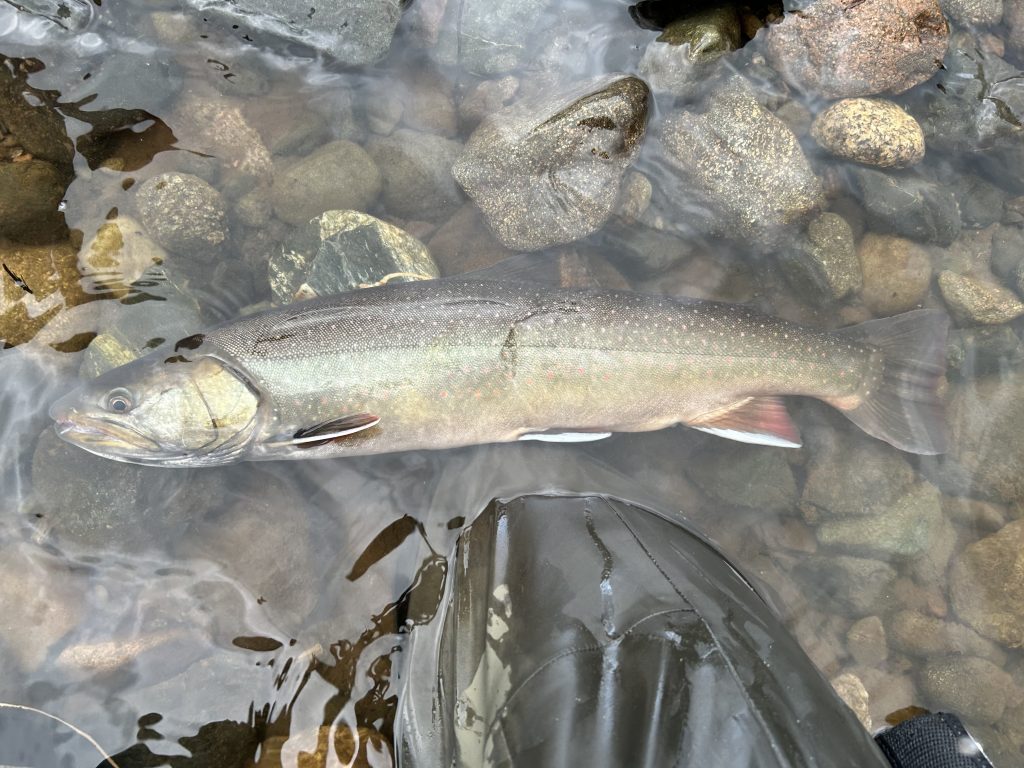
Now that we know what a Bull Trout is, and what its not (or at least appreciate the finer nuances of the conversation) lets discuss what makes them so interesting, both from an angling and ecological perspective. Much like the Pacific Salmon of the west coast, Bull Trout are migratory and capable of homing over vast distances to their natal stream. Many populations travel hundreds of kilometres to return to the pristine headwaters where they were born and lived as juveniles. This often involves herculean efforts to ascend waterfalls and cascades that no other fish species can pass. These migratory Bull Trout are the ones that most anglers like to target, well, because people like catching big fish. Some migratory Bull Trout live entirely in streams, making migrations between large mainstem habitats and spawning tributaries, whereas others live primarily in lakes, and only migrate and hold in streams for a short time each year, usually for spawning. In some cases, Bull Trout will take on a stream resident life-history, living their entire lives in a single stream or reach and only achieve a modest size compared to their migratory counterparts.
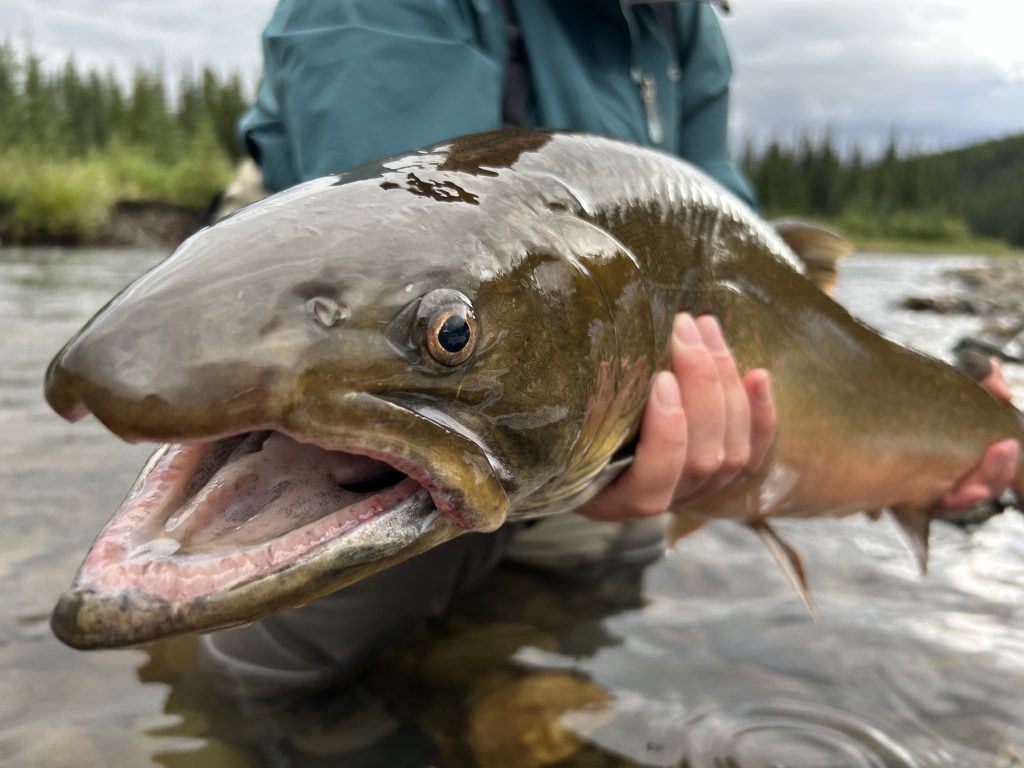
The largest Bull Trout in the province are associated with large lakes and reservoirs. The ability to live in both lake and stream environments is a key trait that has allowed them to persist in regions of BC where vast and diverse stream networks have been flooded by reservoirs, such as the Koocanusa Reservoir, Arrow Lakes Reservoirs, and the Williston Reservoir. The Bull Trout that live in these bodies of water are likely some of the biggest in the world, offering some truly unique angling opportunities.
Finding and Catching Large Char
One of the key things to understand about Bull Trout, and likely most migratory salmonids, is that they are more then a collection of cells in water. They have brains, which means they have motives for being where they are. These motives might not be as straightforward as one might think.
Bull Trout are social creatures, and as migratory populations begin moving into streams in July and August prior to spawning, their motives are often not things like habitat quality or prey availability. Their motives are likely more similar to teenagers at a high school dance. They want to check out their potential dance partners from afar, while simultaneously make every effort they can to catch the attention of those potential dance partners. Bull Trout this time of year are “strutting their stuff,” so to speak. This results in a behaviour known as staging, where Bull Trout group up in the weeks before spawning, forming large congregations of fish. The locations for these gatherings are not random – they are seemingly passed down from generation to generation.
Finding these aggregations is they key to catching migratory char. The problem many anglers run into is they focus to hard on the habitat, such as deep pools, without realizing the behavior isn’t really driven by habitat. Staging areas are not always the deepest pools, or the obvious spots. They are typically quite subtle. If you’re exploring a new system for the first time, you may need to cover a whole bunch of good-looking water to find the one or two spots where they are grouped together. As the old adage goes, “if you know, you know.” This behaviour can also leave Bull Trout vulnerable to exploitation, especially if the staging areas are nearby roads. So, with that in mind… if you do know, be careful who you tell.
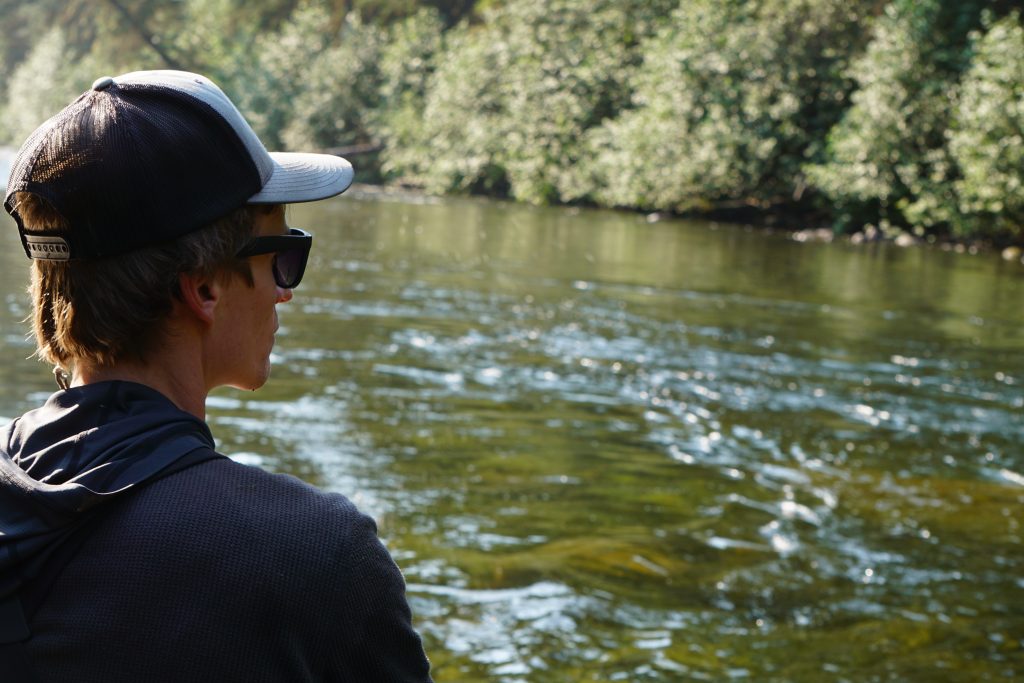
Bull Trout really should not be targeted beyond mid-August, as by this time most adults will be spawning soon.Peak spawning usually occurs around the first week of September (earlier for northern populations) and is finished by mid-September. With this said, it should be acknowledged that within a Bull Trout population, there are subadults who are not yet mature as well as mature fish that may forego spawning. So just because a Bull Trout is caught in the fall, doesn’t mean it was a spawner. But if you see a very large fish in a very small stream, you can safely assume it will spawn soon and should probably leave it alone.
Bull Trout have high survival following spawning, and this post-spawn period can provide excellent fishing as fish returning to their feeding and overwintering grounds following spawning often have voracious appetites. For this reason, there is typically good fishing for Bull Trout in large mainstem habitats in October and November as fish returning from a number of spawning tributaries all partake in a feeding frenzy in preparation for a long winter.
Early spring can also provide excellent fishing for migratory Bull Trout, particularly in natural lakes which support spawning salmon. Bull Trout that live in the lake or adjacent rivers will often congregate at lake outlets in early-spring to gorge on salmon smolts migrating to the ocean. This can lead to excellent Bull Trout fishing at lake outlets using smolt patterns.
Presenting the Fly
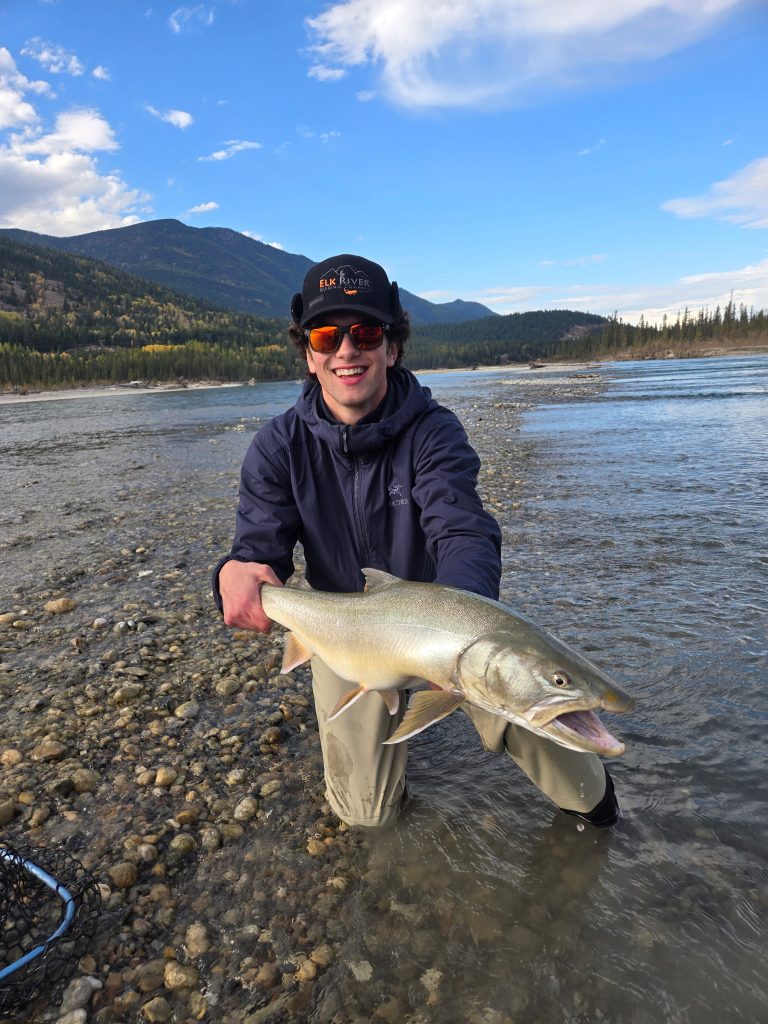
Migratory Bull Trout are geared towards eating fish, so streamer patterns that imitate prey fish are the key to catching larger fish. With that said, there has been a growing movement of anglers targeting bull trout with ultra-large, double articulated monster streamers with gaudy foot-long hunks of rabbit strips. These likely work very well in certain settings (lakes, mainstem habitats with lower visibility, etc.). However, there is a point where bigger, and flashier, isn’t better.
I will acknowledge the argument that bigger fish eat bigger fish and therefore if you want to catch the biggest fish, you should use the biggest fly. My counter argument to this point is that Bull Trout have eyes. Very good eyes, in fact. If you use flies that are too big, with too much flashy stuff, there is a higher chance a fish might recognize the disturbance as artificial, whereas a smaller fly with more natural fibers is less likely to arouse suspicion. Plus, who wants to cast a foot long strip of wet rabbit fur that weighs a pound?
I prefer to keep it simple. A simple bucktail streamer (or similar) is my go-to fly for Mountain char. Another that works well is an olive double bunny— simply two small strips of rabbit tied onto dumbbell eyes. This fly works well in deeper more turbulent waters. My preference is for natural materials and limited accessories. A streamer 10 cm in length tied on a medium (#2-6) hook is usually more than enough to attract the attention of the largest fish. Of course, maybe my aversion towards casting grossly oversized flies has prevented me from truly catching the largest fish. I’ll never know.
Strippers and Swingers
When it comes to char fishing, there are strippers, and there are swingers. Both methods are effective, and stripping can often be necessary in deeper and slower water, whereas a true swing might work best in large mainstem habitats. The best method, in my opinion, is to set a gentle downstream swing angle, and make, small, twitchy strips as the fly swings through the meat of the pool. The resulting line tension will help you set the hook, while the strips will help get the fishes attention and induce a strike. Using a sink tip to help get your fly to an appropriate depth will help you catch fish, especially as the summer progresses and Bull Trout become less focused on feeding. If you are moving a fish, but can’t get em’ to bite, try different patterns of stripping with different amounts of pause. If a fish has touched your hook and won’t return, try changing your fly to a different style or color. Or, better yet, try taking a nap – this rarely fails.
When targeting Bull Trout, use stout tackle—a 6- to 8-weight rod, strong leaders, and heavy tippet. These fish fight hard and often lurk near snags, so be ready for a battle. This will also help reduce fight time and ensure the fish can swim away happy, with no jewellery.
British Columbia’s Bull Trout Hotspots
BC’s landscape contains hundreds of rivers and lakes harbouring healthy populations of migratory Bull Trout and Dolly Varden. However, finding these fish requires research and a willingness to explore off the beaten path. Here are some iconic destinations that offer anglers the best shot at catching a trophy Bull Trout:
- Kootenay River/Koocanusa Reservoir: The Kootenay River/Koocanusa reservoir and its tributaries are legendary for Bull Trout. These rivers weave through mountain valleys and offer classic streamer fishing in breathtaking surroundings. The Kootenay River, in particular, is known for excellent Bull Trout fishing in the late fall.
- Columbia River/Arrow Lakes Reservoirs: The mighty Columbia and it’s tributaries, particularly in the Arrow Lakes region which has been impounded by dams, holds some impressive lake dwelling and Bull Trout.
- Upper Fraser River tributaries: While the Fraser itself is better known for salmon, its colder tributaries in the Cariboo and Rocky Mountains offer excellent Bull Trout fishing for large river-migratory Bull Trout.
- Upper Peace River/Williston Reservoir: Northeastern BC is home to some of the most pristine Bull Trout habitat in the province. Bull Trout that inhabit BC’s largest body of water, the Williston Reservoir, can reach epic proportions.
Bull Trout Conservation
Bull Trout, despite being widespread in the province, are susceptible to human impacts, including industrial development, angling exploitation, and habitat fragmentation. The sensitivity of the species means every angler targeting Bull Trout must be a steward for their health and longevity. Here are some ways you can help protect this remarkable species:
- Practice Ethical Catch-and-Release: Use barbless hooks, handle fish gently, keep them in the water, and release them quickly. Know when to put the rod away. Avoid fishing during spawning times or when water temperatures rise above 15°C.
- Support Habitat Protection: Get involved with local conservation groups, donate to habitat restoration projects, and advocate for strong environmental regulations at provincial and federal levels.
- Respect Regulations: Follow all regional regulations and check the regulations for the specific body of water you intend to fish.
- Spread the Word: Share your knowledge and passion for the species. Teach new anglers about the importance of stewardship, and celebrate Bull Trout not just as a sportfish, but as a symbol of pristine wilderness.
A Final Word, for Chars Sake
I want to make it clear that pretty well everything I’ve stated in this article about Bull Trout, from a fishing perspective, also applies to Dolly Varden. But they are DEFINITLEY not the same thing. Perhaps adopting a new name, Mountain Char, will help you prevent further confusion.
I hope you learned a thing or two about this species (or two) and are excited to catch a char next time you hit the water. But do not forget: these fish survived two ice ages, colonized some of the most inhospitable landscapes on earth, and regularly ascend sheer waterfalls, simply to exist. Throw some respect on their names— whichever one you choose.
2 thoughts on “Trout by Name, Char by Nature: The Bull Trout Identity Crisis”
Right on, great article and information.
Thank you Mark, appreciate that